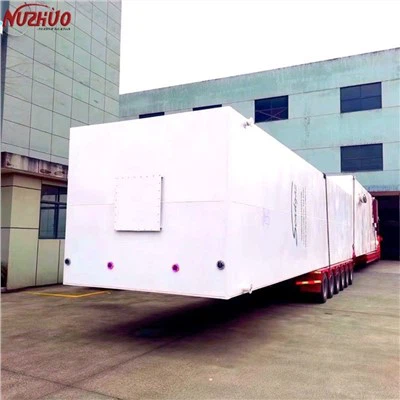
The working principle of a nitrogen generator (taking the currently used pressure swing adsorption as an example): The nitrogen generator uses compressed air as the raw material and carbon molecular sieve as the adsorbent. Under a certain pressure, the adsorption of oxygen in the air by carbon molecular sieve is much greater than that of nitrogen. Therefore, most of the oxygen in the air will be adsorbed, while nitrogen will be left behind and enter the system through the exhaust pipeline. According to the different characteristics of carbon molecular sieves in terms of adsorption capacity of adsorbed gases under different pressures, the adsorption of oxygen on molecular sieves will decrease under low pressure conditions. By reducing the pressure inside the adsorber, the adsorption of oxygen on molecular sieves is reduced, releasing the adsorbed oxygen, which is the regeneration process of molecular sieves. By using programmable control of the opening and closing of pneumatic valves, alternating circulation between towers A and B can be achieved, with pressurized adsorption and decompression regeneration to complete oxygen nitrogen separation and obtain qualified nitrogen. It should be noted that carbon molecular sieves can simultaneously adsorb oxygen and nitrogen in the air, and their adsorption capacity also increases with increasing pressure. Moreover, there is no significant difference in the equilibrium adsorption capacity of oxygen and nitrogen at the same pressure. Therefore, it is difficult to achieve effective separation of oxygen and nitrogen solely based on pressure changes. If further consideration is given to adsorption speed, the adsorption characteristics of oxygen and nitrogen can be effectively distinguished. The diameter of oxygen molecules is smaller than that of nitrogen molecules, Therefore, the diffusion rate is hundreds of times faster than nitrogen, so the adsorption rate of oxygen on carbon molecular sieves is also very fast, reaching over 90% in about one minute; At this point, the adsorption amount of nitrogen is only about 5%, so at this point, most of the adsorbed oxygen is oxygen, while the remaining nitrogen is mostly nitrogen. In this way, if the adsorption time is controlled within 1 minute, oxygen and nitrogen can be preliminarily separated. In other words, adsorption and desorption are achieved by pressure difference, with adsorption occurring when the pressure increases and desorption occurring when the pressure decreases. The distinction between oxygen and nitrogen is achieved by controlling the adsorption time, which is very short. Oxygen has been fully adsorbed, while nitrogen has not yet had time to adsorb, and the adsorption process stops. Therefore, pressure swing adsorption nitrogen production requires a change in pressure and the time should be controlled within 1 minute 4、 Understand other types of nitrogen generators 1. Deep cooling air separation nitrogen generators: Deep cooling nitrogen generators can not only produce nitrogen but also liquid nitrogen, meeting the process requirements for liquid nitrogen. They can also be stored in liquid nitrogen storage tanks. When there is an intermittent load of nitrogen or minor repairs to the air separation equipment, the liquid nitrogen in the storage tank enters the vaporizer and is heated before being sent to the product nitrogen pipeline to meet the nitrogen demand of the process unit. Deep cold air separation for nitrogen production uses air as the raw material, which is compressed, purified, and then liquefied into liquid air through heat exchange. Liquid air is mainly a mixture of liquid oxygen and liquid nitrogen. By utilizing the different boiling points of liquid oxygen and liquid nitrogen (at 1 atmospheric pressure, the former has a boiling point of -183 ℃, while the latter has a boiling point of -196 ℃), nitrogen is obtained by separating them through distillation in the liquid air. The cryogenic air separation nitrogen production equipment is complex, covers a large area, has high infrastructure costs, has a large one-time investment, high operating costs, slow gas production (12-24 hours), high installation requirements, and a long cycle. The cryogenic air separation nitrogen production device is suitable for places with large-scale industrial nitrogen production and liquid nitrogen requirements, while medium and small-scale nitrogen production appears uneconomical.